How vibe-coding is empowering SMEs to build their own internal tools
We’re blessed in the information age to be able to learn from the mistakes of people we’ll never meet.
As brilliantly explained by Jack Skeels, AI excels at the nexus of highly solved, low-risk work. Giving certain members of society access to AI coding agents is akin to arming a bonobo with a shotgun; for others, those looking to improve our lives and the way we work rather than just get-rich-quick, it represents a paradigm shift away from the rent-seeking stranglehold of horizontal SaaS platforms.
Bypassing the quagmire
Until recently, to solve an organisational tooling problem non-technical teams had to choose the least of three evils:
- submit a request to their disinterested IT department and wait months or years for progress;
- build their dream tool with a digital agency at the cost of tens of thousands of dollars upfront;
- or, pay hundreds of dollars per seat per month for a horizontal SaaS platform that only partially fit their workflow.
Vibe-coding introduces a new way forward: a world where a bespoke internal dashboard, portal or CRM can be created in days using cheap and readily available AI agents. Simply draw up your requirements, plug them into a prompt box and away you go.
Not all sunshine and rainbows
Vibe coding is not without its risks and drawbacks. Researchers discovered in June 2025 that 10.3% of applications generated by Lovable had critical vulnerabilities, allowing attackers access to real user data via access control exploits. Stories abound of “no-code SaaS founders” talking about their build process online and finding themselves the targets of malicious actors.
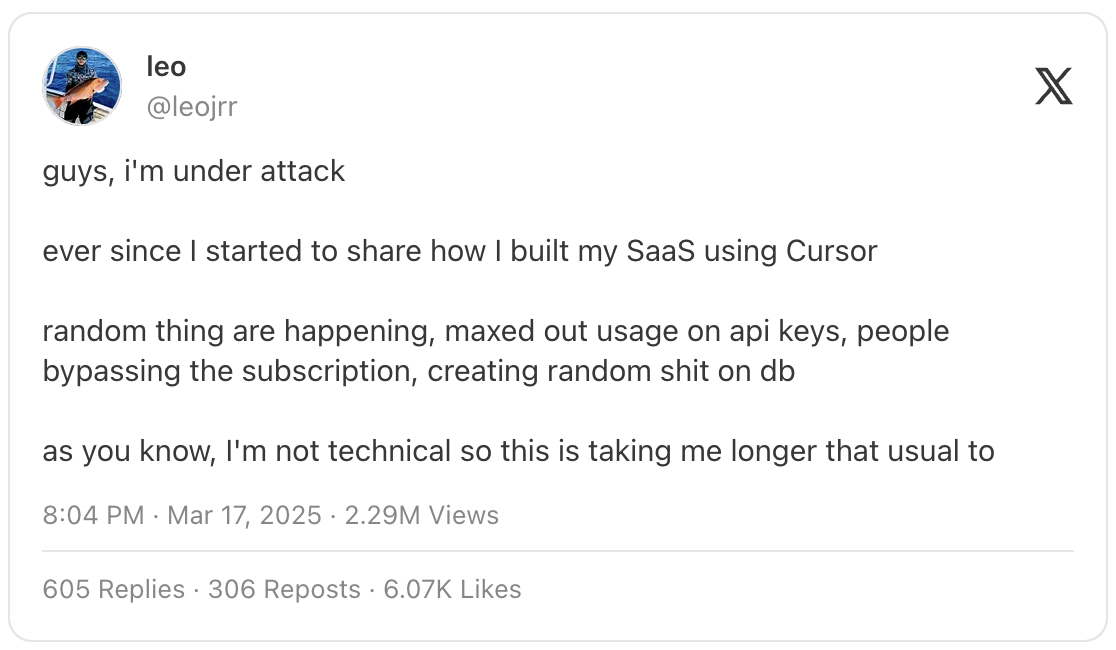
AI agents optimise their workflows for speed of delivery rather than taking a security-first approach to architecture and development. If your vibe-coded tool is handling sensitive information, always get a developer to review it before it goes near a live environment.
AI is a crane, not an architect
The invention of glass and steel did not give rise to skyscrapers in Ancient Rome.
Similarly, LLMs do not signal the extinction of the web developer: AI is an incredible technological development but it is first and foremost a tool, and like any tool it is most valuable in the hands of a craftsman. Coding agents excel at automating boilerplate but their heuristic “decision-making” quickly starts to fall apart whenever real-world constraints are introduced: data security and privacy, compliance, third-party integrations, web infrastructure and hosting.
There’s also an accountability gap. Most of us by now have experienced the joys of AI-only customer service lines: imagine that but you’re trying to get your invoicing system fixed at 11pm on a Friday night.
A digital agency making correct use of AI tooling can now get a client from brief to working prototype in days rather than weeks, leaving more of the project budget to iterate on user feedback and create an amazing piece of software.
Vibe coding is perfect for simple, small-scale, low-risk use cases: a way to bridge the gap between idea and working prototype for non-developers. For those parts of your workflow that need scale, complex integrations or compliance… those are better left to the professionals.